
Marine LED Fishing Lights for Commercial Fishing Vessels
Our marine LED fishing lights are designed for offshore fishing vessels, squid boats, purse seine vessels, trawlers, and commercial night fishing fleets. Available in 600W, 800W, 1000W, and 1200W options, with wide-voltage AC input (100–320V), IP68/IP69K waterproof protection, corrosion-resistant marine-grade housing, and green, white, blue, or cyan light options for different fishing applications and target species.
Need a lighting layout for your vessel? Share your vessel length, generator voltage, target species, and fishing area to receive a recommended fixture configuration.
Product Range Overview
| Product Series | Wattage | Voltage | IP Rating | Light Color | Suitable Vessel Type |
|---|---|---|---|---|---|
| Above-water LED fishing light | 600W–1200W | 100–320V AC | IP68/IP69K | Green / White / Cyan / Blue | Squid boats, purse seine vessels, offshore fleets |
| Underwater fishing light | 300W–1000W | AC / DC options | IP68 | Green / Blue / White | Bait attraction, pelagic fishing |
| LED squid fishing light | 800W–1200W | 100–320V AC | IP68/IP69K | Green / Cyan / White | Squid jigging, falling-net vessels |
| Green LED fishing light | 600W–1200W | 100–320V AC | IP68/IP69K | 520–570 nm | Mixed water clarity, offshore fishing |
| Marine night fishing light | 300W–1000W | 100–320V AC | IP68 | White / Green | Deck illumination, general night operations |
Standard Specifications
| Specification | Available Options |
|---|---|
| Power | 300W / 600W / 800W / 1000W / 1200W |
| Input Voltage | 100–320V AC, 50/60Hz; optional 24V DC |
| Light Color | Green, white, blue, cyan |
| Wavelength | Green 520–570 nm; cyan 490–520 nm; blue 425–490 nm |
| Waterproof Rating | IP68 / IP69K (depending on model) |
| Housing | Marine-grade aluminum with thermal fin array |
| Bracket | 316 stainless steel |
| Surge Protection | 10kV (standard or optional depending on model) |
| Luminous Efficiency | Up to 120 lm/W (COB models) |
| Lifespan | 20,000–50,000 hours (L70 rated) |
| Mounting | Mast, rail, crossbeam, side frame, deck structure, gunnel |
| Certifications | CE, RoHS, EMC-compliant driver available |
What Are Marine LED Fishing Lights Used For?
Marine LED fishing lights operate at night to attract phototactic marine species — organisms that naturally move toward light sources. The mechanism works through a cascading food chain effect: underwater or above-water light draws phytoplankton and zooplankton, which concentrate baitfish, which in turn attract the target species.
Commercial fishing applications include:
Squid jigging and falling-net fisheries. Squid are strongly phototactic. Vessels targeting squid (Loligo spp., Todarodes pacificus, arrow squid, market squid) deploy high-wattage above-water LED fishing lights — typically green or cyan wavelength — in arrays along both sides of the vessel. Night fishing light arrays draw squid to the surface where jigging or dip-net gear operates.
Purse seine light fishing. Before setting the net, purse seine vessels use LED fishing lamps to concentrate mackerel, sardines, anchovies, and other small pelagics around the vessel. The light aggregates the school, allowing the net to be set around a denser, more stationary target.
Lift-net and stick-held falling-net operations. These gear types in Southeast Asia and the Pacific rely almost entirely on light attraction. Vessels in this category have historically used the highest-wattage metal halide arrays — making them the segment with the greatest LED conversion opportunity in terms of fuel savings.
Offshore pelagic and tuna operations. Underwater fishing lights deployed from transom or hull create a water column glow that aggregates bait and holds pelagic gamefish — tuna, wahoo, mahi-mahi — near the vessel during drift or anchor situations. Above-water marine LED fishing lights extend the aggregation zone to the surface.
Bait collection and live-bait retention. Longline vessels and offshore commercial operations use fishing lights to attract and hold baitfish near the vessel or in live-well intake areas, supporting bait aggregation and live-bait holding during offshore operations.
Deck and processing illumination. Trawlers, factory vessels, and fish processors need high-CRI white LED work lights for sorting, grading, and processing fish under accurate color rendering. These are functionally different from attraction lights but often share the same marine-grade fixture construction.
Marine LED Fishing Light Product Series
Commercial fishing vessels have different lighting requirements depending on gear type, target species, and fishing depth. The following product series cover the main commercial applications.
Above-water LED fishing lights mount on the vessel superstructure — masts, gunnels, crossbeams, or purpose-built brackets — and direct high-intensity beams toward the water surface. This is the primary type used in commercial squid, purse seine, and lift-net fisheries. No hull penetration is required, and fixtures are straightforward to inspect, clean, and replace between seasons.
Underwater fishing lights are deployed below the waterline on cables or fixed transom brackets. They reduce surface reflection losses because the light is emitted directly into the water column rather than passing through the air-water interface. These are used in offshore pelagic operations, bait-attraction scenarios, and shallow-water shrimp and prawn operations. For below-water attraction, see our [underwater fishing lights] designed for bait aggregation, pelagic fishing, and submersible marine use.
LED squid fishing lights are high-wattage above-water units optimized for the green and cyan wavelengths that squid research has identified as most effective for coleoidea attraction. They are commonly configured in 800W–1200W outputs and are built for the duty cycles of nightly squid jigging and falling-net operations. For squid jigging and falling-net operations, explore our [LED squid fishing lights] for full wattage options and mounting configurations.
Green LED fishing lights are configured specifically at 520–570 nm wavelength output and represent the most common commercial choice for mixed-species night fishing in coastal and offshore environments. See our [green LED fishing lights for commercial vessels] for available wattages and mounting options.
Marine night fishing lights (above-water flood configuration) provide broad-area deck and water-surface illumination for vessels where night-time crew visibility and work-area lighting are the primary requirement, alongside attraction functionality. Explore our [marine night fishing lights] for deck and processing applications.
Not sure which series fits your vessel? Send your vessel length, mounting height, target species, and generator voltage for a fixture layout recommendation.
Wattage Selection: 300W, 600W, 800W, 1000W, 1200W
Wattage is the most consequential specification for commercial buyers because it determines both the size of the attraction zone and the electrical load the vessel must support. Higher wattage does not always produce proportionally more fish — beam optics, wavelength, and fixture count interact with wattage to determine actual performance.
Wattage by Vessel Type
| Vessel Type | Suggested Wattage per Fixture | Typical Setup |
|---|---|---|
| Small coastal vessel (under 15m) | 300W–600W | 2–6 fixtures total |
| Inshore squid boat | 600W–800W | Multiple units per side |
| Offshore squid vessel | 800W–1200W | 8–20+ fixtures total |
| Purse seine vessel | 1000W–1200W | High-output array, both sides |
| Trawler / demersal working vessel | 300W–600W | Attraction + deck work support |
| Factory vessel / fish processor | 300W–800W | Deck and processing area coverage |
COB vs. Chip Array at High Wattage
Most commercial-grade fishing LED lights above 600W use COB (Chip-on-Board) LED modules. A COB module integrates multiple LED chips on a single substrate, achieving up to 120 lm/W luminous efficiency in a compact form factor. This concentrates high output in a smaller physical aperture, allowing precision optics to direct the beam into the water column rather than losing energy as scatter.
At equivalent lumen ratings, a COB fixture with precision optics consistently delivers more usable underwater illumination than a multi-chip flood array with diffuse output. For commercial buyers comparing specifications, ask manufacturers for illuminance data (lux at specific distances) rather than relying solely on total lumen ratings from the fixture output.
Voltage and Generator Compatibility
Commercial fishing vessel electrical systems are not standardized. Generator voltage, frequency, and DC bus configurations vary by vessel age, flag state, and regional conventions. Before specifying any LED fishing light fixture, confirm the following electrical parameters.
AC input range. Quality commercial marine LED fishing lights accept wide-range AC input — typically 100–320V AC at 50 or 60 Hz. This range covers the generator configurations most commonly used in commercial fishing fleets, including 110V/60Hz (Americas) and 220–240V/50Hz (Europe, Asia, Australia). For vessels with 380V three-phase systems, verify whether the fixture will be connected phase-to-neutral at 220–240V or whether a dedicated driver or transformer is required. Do not connect a 100–320V AC fixture directly to 380V line-to-line power unless the manufacturer explicitly confirms compatibility.
Generator capacity. Calculate total lighting load before specifying fixture count. A vessel deploying 10 × 1,000W LED fishing lights carries a 10 kW continuous electrical load from lighting alone, before navigation electronics, refrigeration, hydraulics, and propulsion support systems. Work with your vessel's electrical engineer to confirm the generator can sustain full rated output load with appropriate derating margins for tropical ambient temperatures.
24V DC configurations. Some smaller coastal fishing vessels, particularly those below 15 meters, operate on 24V DC electrical systems rather than AC generators. LED fishing lights in the 300W–600W range are available in 24V DC configurations. These are suitable for coastal and inshore operations but are not practical for the higher wattage requirements of offshore light-fishing fleets.
EMC compliance. LED drivers that do not meet electromagnetic compatibility (EMC) standards emit electrical interference that can affect GPS, fish finders, sonar, and VHF radio — all critical systems on a working fishing vessel. Specify fixtures with EMC-compliant LED drivers; CE and EMC documentation should be available on request. This is particularly important in high-wattage multi-fixture arrays where cumulative interference can be significant.
Cable specification. Marine-grade cable — tinned copper conductors, UV-resistant jacketing, rated for continuous wet exposure — is required for all commercial fishing light installations. Standard electrical cable corrodes rapidly in marine environments, particularly in saltwater spray zones. Use waterproof cable glands at all penetration points.
IP Rating: IP68 vs. IP69K for Marine LED Fishing Lights
The ingress protection (IP) rating classifies how well a fixture's housing is sealed against water and particulate ingress. Use IEC 60529 / IP Code terminology as the baseline when comparing IP65, IP67, IP68, and related marine enclosure ratings. On a commercial fishing vessel, this is a baseline safety and reliability specification — not an optional upgrade.
IP65: Protected against water jets from any direction. Adequate for sheltered deck locations that will not experience green water or direct spray. Not adequate for transom mounting, submersible use, or any position exposed to wave action.
IP67: Protected against temporary submersion to 1 meter for 30 minutes. Entry-level for transom or low-side mounting where occasional wave splash immersion is possible.
IP68: Protected against continuous submersion at the depth and duration specified by the manufacturer (typically 3–10 meters). For exposed commercial fishing vessel installations — particularly fixtures mounted near the rail, transom, or splash zone — IP68 is the recommended practical standard. Commercial fishing operations regularly subject deck-level fixtures to direct saltwater contact through wave action, green water, and spray.
IP69K: Protected against high-pressure, high-temperature washdown (80°C water at 100 bar pressure, per DIN 40050-9). On commercial fishing vessels where deck washdowns with high-pressure hoses are routine after each trip — which is standard practice on trawlers, squid boats, and purse seine vessels — IP69K-rated fixtures eliminate a failure mode that causes LED driver seal failure in IP68-only units. The structural robustness required to pass IP69K testing also provides better resistance to the vibration loads generated by vessel engines and sea conditions.
Recommendation for commercial buyers:
- Above-water LED fishing lights on commercial vessels: IP68 recommended for rail, transom, and splash-zone positions; IP69K preferred where regular high-pressure washdowns occur.
- Underwater fishing lights (submersible): IP68 required for the fixture and all cable terminations.
- Deck and processing area lights: IP65–IP68 depending on exposure level.
Corrosion Resistance for Saltwater Fishing Vessels
IP ratings address water ingress into the electrical components. Corrosion resistance is a separate — and equally important — durability consideration for commercial marine LED fishing lights operating in saltwater environments.
Saltwater corrosion attacks dissimilar metals, unprotected aluminum, untreated fasteners, and unshielded cable terminations. On a commercial vessel operating daily in offshore salt spray, corrosion is the primary cause of premature fixture failure after water ingress.
Housing material. Marine-grade aluminum alloy (typically 6061 or 6063 series) is the standard for commercial LED fishing light housings. The housing should carry an anodized finish or marine-grade epoxy powder coating to resist salt spray. Bare aluminum in direct saltwater contact will corrode through pitting within one to two seasons on a working vessel.
Bracket and fastener specification. 316 stainless steel is the minimum grade for mounting brackets and fasteners in saltwater environments. 304 stainless steel — common in general-purpose hardware — has lower molybdenum content and exhibits crevice corrosion in chloride-rich marine environments over time. Verify the alloy grade on any mounting hardware supplied with commercial fixtures.
Sealed driver chamber. The LED driver (power supply) is more vulnerable to corrosion than the LED chips themselves. High-quality commercial fishing lights enclose the driver in a fully sealed, potted, or separated chamber with its own gasket and seal system independent of the LED face.
Cable glands and penetrations. All cable entry points on commercial LED fishing lights should use marine-grade waterproof cable glands — brass or stainless steel body, EPDM sealing insert. Plastic cable glands degrade under UV exposure and vibration within two to three seasons.
Antifouling consideration for submersible units. Underwater fishing lights deployed on a regular schedule accumulate biofouling — algae, barnacles, and marine growth — that reduces light output over time and can block thermal dissipation vents on some designs. On commercial vessels where dry-docking intervals may be 12 months or more, specify submersible units with antifouling-compatible housings, or plan for in-water periodic cleaning.
LED Color and Wavelength Selection
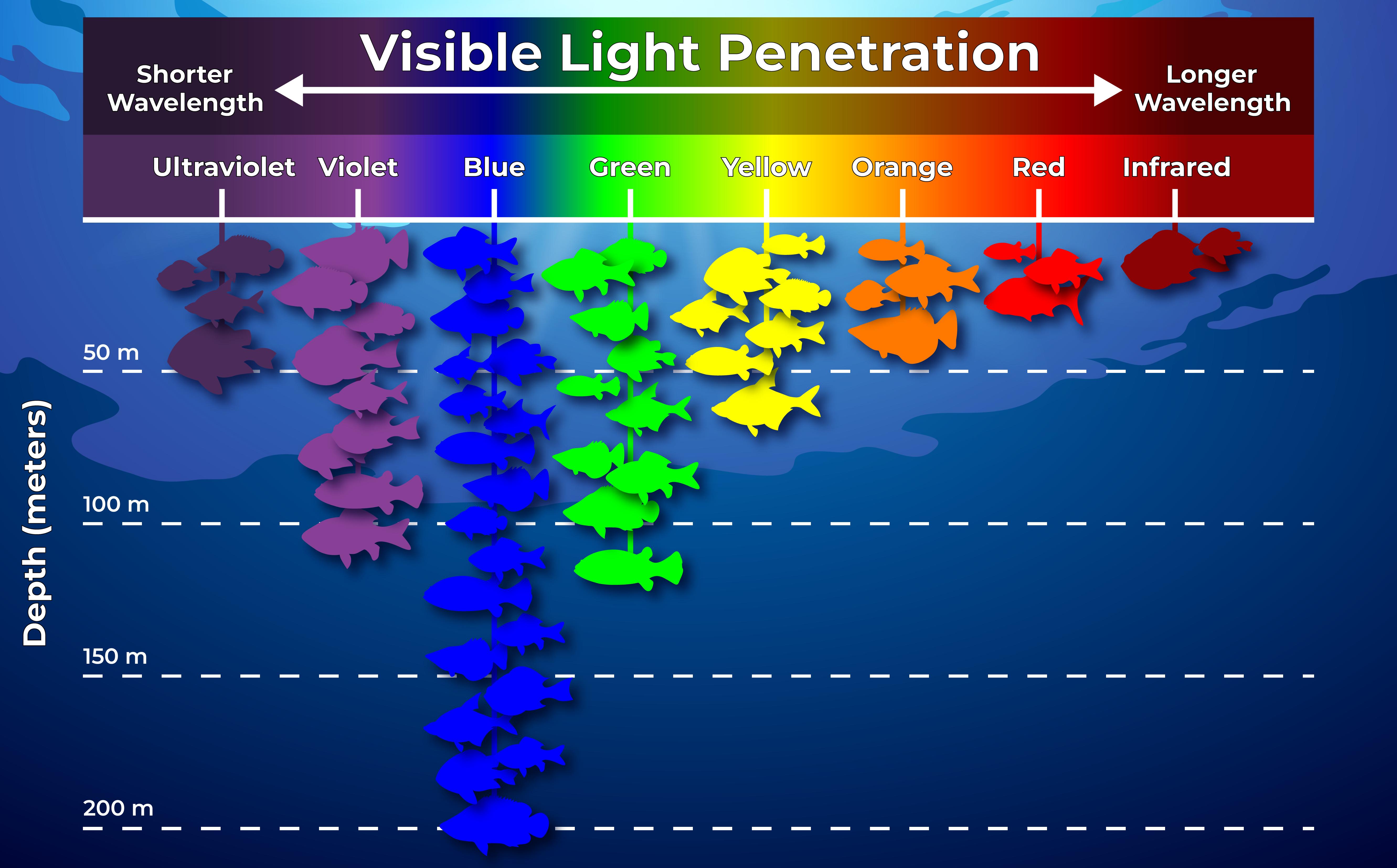
Light color on a commercial fishing vessel is a catch variable. The underlying mechanism is phototaxis — the movement of marine organisms toward light — and different wavelengths produce different effects at different water depths and clarity levels.
Green (520–570 nm): Versatile Choice for Commercial Fishing
Green light penetrates further than most other visible wavelengths across the range of water conditions encountered in commercial fishing — from turbid coastal water to moderately clear offshore environments. At 520–570 nm, it scatters less than shorter blue wavelengths in murky conditions and attenuates less rapidly than longer red and yellow wavelengths in clear water.
Green is widely used in commercial squid fishing fleets across Asia, South America, and parts of the Pacific market. It performs consistently across variable water clarity, which matters for operators moving between fishing grounds.
A 2013 study in South China Fisheries Science found that cyan LED lamps — sitting at the blue-green junction near 490–520 nm — significantly increased catches of coleoidea (squid and cuttlefish) on falling-net vessels in the South China Sea. [5] This has driven adoption of cyan as a supplementary or primary color in dedicated squid light arrays.
White: High-Lumen, Broad-Spectrum Output
White LED fishing lights produce the highest total lumen output of any single-color option because white LEDs emit across the full visible spectrum. White light can be effective for lateral baitfish aggregation in clear-water applications where broad-spectrum visibility is useful.
White light performs best in clear offshore water conditions and is the standard for deck and fish-processing area illumination where high CRI (color rendering index) matters for crew visibility and fish-quality assessment.
Blue (425–490 nm): Clear-Water Applications
Blue light can perform well in very clear tropical or deep-water conditions, where its shorter wavelengths work effectively at depth. In turbid coastal water, however, blue light scatters more readily and often loses practical penetration compared with green. Some commercial operators pair blue fixtures with green arrays in clear-water fishing grounds for species-specific coverage.
Cyan (490–520 nm): Squid-Specific Configuration
Cyan sits between blue and green and has shown specific effectiveness for squid and cuttlefish in controlled fishery research. A 2024 PLOS ONE study on falling-net vessels in the South China Sea reported that adding cyan LED lamps to a white LED configuration increased coleoidea catches in the first experiment, while the second experiment showed that all-cyan configurations can change catch composition and should be evaluated carefully by fishery type. Squid jigging vessels and falling-net operators should evaluate cyan as a primary or supplementary color based on target species, water clarity, and vessel layout.
Installation and Mounting Layout
Mounting Height and Coverage
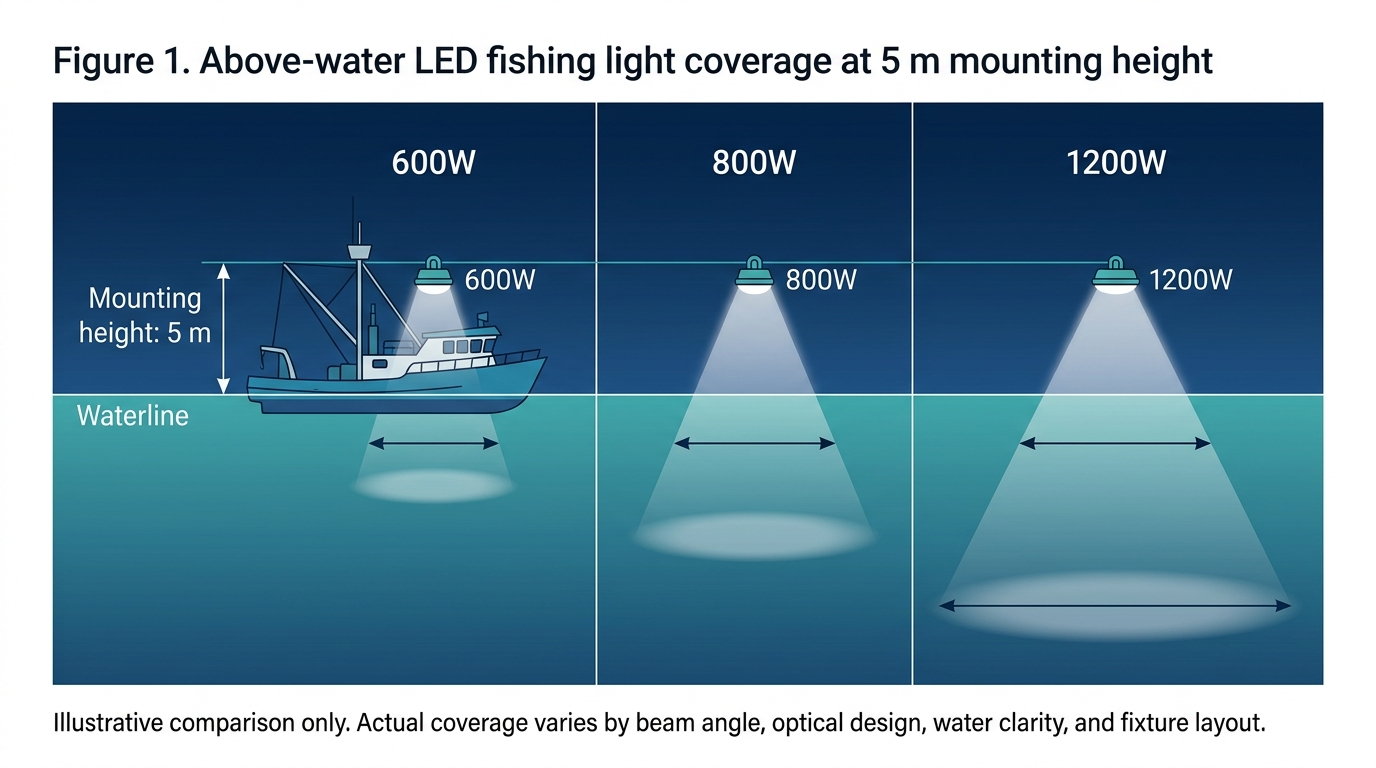
Above-water LED fishing lights mounted higher on the vessel produce a wider illuminated footprint on the water surface, but beam intensity at the water plane decreases with mounting height. Commercial operators on squid and purse seine vessels typically mount fixtures 4–8 meters above the waterline. Below 3 meters, the illuminated area is too small for effective commercial aggregation. Above 10 meters, beam intensity at the water surface may be insufficient for deep-column penetration without very high-wattage fixtures.
Fixture Spacing and Array Configuration
Multiple fixtures in a commercial array should produce overlapping coverage zones across the vessel's working side, without creating excessively bright hot spots. A practical guideline is to space fixtures so each unit's 50% illuminance contour overlaps with adjacent units at the water surface. For vessels running arrays of 8–20 fixtures per side, this typically means fixtures spaced 1.5–3 meters apart along the rail or mast arm.
Typical mounting positions on commercial fishing vessels include:
- Mast and boom arm (high mounting for wide coverage)
- Side rail and gunnel (mid-height lateral mounting)
- Crossbeam and deck frame (forward and aft array positions)
- Superstructure face (enclosed bridge or wheelhouse forward face)
Heat Dissipation in Tropical Operations
High-wattage LED fishing light fixtures generate substantial heat at the driver and LED substrate. In tropical fishing grounds where ambient night temperatures remain above 28–30°C, fixtures without adequate thermal management throttle output or fail prematurely through LED junction temperature exceedance. Aluminum housings with external fin arrays are the standard solution; verify that fixtures are rated for the ambient temperature range of your operating area.
Cable Routing and Weatherproofing
Run marine-grade cable through dedicated conduit or cable tray where possible on permanent commercial installations. Seal all cable penetrations through deck or superstructure with marine-grade waterproof fittings. Apply anti-corrosion compound to all terminal block and connector contacts. Schedule annual inspection of all cable terminations, glands, and bracket fasteners as part of vessel maintenance.
ROI: LED Fishing Lights vs. Metal Halide Lamps
The economic case for converting commercial fishing vessels from metal halide to LED fishing lights is documented across multiple peer-reviewed studies in different fishery types and regions.
Power reduction without catch loss. A 2024 PLoS ONE study of falling-net vessels in the South China Sea found that 36 kW of LED lamps maintained equivalent catch rates to 120 kW of metal halide lamps — a 70% reduction in lighting power draw with no statistically significant change in catch volume. [1] A separate Fisheries Research study documented that 60 kW LED output equaled the underwater illuminance of 200 kW metal halide. [3]
Fuel consumption per trip. An Aquaculture and Fisheries study of Vietnamese purse seine vessels measured fuel consumption at 70.8 liters per nightly trip using an LED-metal halide hybrid system, versus 114 liters using metal halide alone — a 37.9% reduction per trip— while reporting no significant difference in catch rates between the lighting treatments. For a vessel running 150 nights per season, this compounds into substantial annual fuel cost savings against marine diesel.
CO₂ emission reduction. The same research body documented potential CO₂ emission reductions of 1.09 tons per trip per boat from full LED conversion on falling-net vessels. [4] For fleets operating under carbon reporting obligations or regional environmental compliance requirements, this has measurable regulatory value.
Maintenance interval and lamp replacement. Metal halide lamps require replacement approximately every 6,000–8,000 hours. Commercial LED fishing lights are rated 20,000–50,000 hours (L70). A vessel running 8 hours per night for 200 nights per year exhausts a metal halide lamp in three to five seasons; an equivalent LED fixture under the same schedule operates for 12–31 seasons before reaching L70 degradation.
Generator load and engine wear. Reduced electrical draw from the lighting system lowers generator load, which affects fuel consumption across the full generator runtime — not just the lighting circuit. Vessels with high-wattage metal halide arrays that run at or near generator capacity particularly benefit from the load reduction.
LED fishing lights carry a higher upfront fixture cost than equivalent-wattage metal halide units. The payback calculation depends on fuel price, operating nights per season, and fixture quantity. Vessels that fish 150+ nights per year in light-intensive fisheries — squid jigging, purse seine, lift-net — typically see the shortest payback periods.
For fleet retrofit projects, we can help compare LED power draw against your existing metal halide setup.
Application Scenarios by Vessel Type
Squid jigging vessels. One of the highest-density LED fishing light applications in commercial fishing. Vessels typically deploy green or cyan above-water LED fishing lamps in arrays of 8–24 fixtures per side. Wattage: 800W–1200W per fixture. Target species: arrow squid, Japanese flying squid, market squid, Humboldt squid.
Purse seine light vessels. Deploy high-output above-water fishing lights before net-setting to concentrate small pelagics — mackerel, sardines, anchovies, herring. Some fleets use a dedicated light boat that attracts the school while the seine vessel sets around it. Wattage: 1000W–1200W in high-output arrays.
Falling-net and lift-net vessels (Asia Pacific). These operations historically used the highest-wattage metal halide arrays, making them a key LED conversion market. Arrays of 20–40+ fixtures per vessel are common. Green and white LED fishing lights are both used, with cyan showing increasing adoption for squid-dominant catch compositions.
Offshore trawlers. Primarily use LED fishing lights for deck illumination and as supplementary attraction lights at anchor or drift. Wattage requirements are lower than dedicated light-fishing vessels: 300W–600W for deck work, 600W–800W for any attraction function.
Offshore bait and longline support vessels. White and green underwater LED fishing lights can be used for bait aggregation and live-bait holding during commercial offshore operations. Above-water marine night fishing lights support deck visibility and crew safety on extended offshore trips. Wattage: 300W–800W depending on vessel size and electrical capacity.
Marine LED Fishing Light Buyer Checklist
| Checkpoint | What to Confirm |
|---|---|
| Vessel type | Squid boat, purse seine vessel, trawler, falling-net vessel, offshore working vessel |
| Fixture wattage | 300W, 600W, 800W, 1000W, or 1200W per unit |
| Power supply | 100–320V AC, 24V DC, or three-phase vessel system — confirm phase-to-neutral voltage |
| Mounting position | Mast, rail, gunnel, crossbeam, transom, superstructure face |
| Waterproof rating | IP68 recommended for splash-zone positions; IP69K where washdowns are routine |
| Housing material | Marine-grade aluminum housing; 316 stainless steel bracket and fasteners |
| Light color | Green (520–570 nm), white, blue, or cyan — matched to target species and water clarity |
| Target species | Squid, sardine, mackerel, anchovy, hairtail, tuna baitfish, shrimp |
| EMC compliance | EMC-compliant LED driver with CE / EMC documentation available |
| Retrofit requirement | Existing metal halide wattage and fixture quantity — for array layout comparison |
| Fixture count | Total number of units per side — based on vessel length and mounting height |
Frequently Asked Questions
What wattage is suitable for a commercial fishing vessel?
Wattage depends on vessel size, target species, fishing depth, and the number of fixtures in the array. Small coastal vessels (under 15m) typically use 300W–600W per fixture. Inshore squid boats work well with 600W–800W units. Offshore squid and purse seine vessels commonly use 800W–1200W fixtures in multi-unit arrays. The per-fixture wattage and the total fixture count together determine the effective attraction zone — consult with your supplier about array configuration for your specific vessel dimensions and operating area.
What voltage do marine LED fishing lights use?
Most commercial-grade marine LED fishing lights accept wide-range AC input: 100–320V AC at 50 or 60 Hz. This covers the most common single-phase generator configurations used in commercial fishing fleets. For vessels with 380V three-phase systems, confirm whether the fixture will be connected phase-to-neutral at 220–240V or whether a transformer or dedicated driver is required. Do not connect a 100–320V AC fixture directly to 380V line-to-line power unless the manufacturer confirms compatibility. Some models support 24V DC for smaller coastal vessels with DC electrical systems. Confirm input voltage range, frequency compatibility, and total power draw before specifying fixtures for your generator capacity.
What IP rating is required for fishing vessel lights?
For exposed commercial fishing vessel installations, IP68 is generally recommended, especially for fixtures near the rail, transom, splash zone, or areas exposed to wave spray. IP69K is preferred where high-pressure washdowns are routine after each trip. For submersible underwater fishing lights, IP68 protection is required for both the fixture and all cable terminations.
Are green LED fishing lights suitable for offshore fishing?
Green light (520–570 nm) penetrates well across a wide range of water clarity conditions — from turbid coastal water to moderately clear offshore environments — making it a practical choice for commercial vessels operating across different fishing grounds. Its performance advantage over blue light is most pronounced in non-crystal-clear water. In very clear tropical offshore water, some operators supplement with white or blue to maximize lateral bait aggregation distance.
How many LED fishing lights does one vessel need?
This depends on vessel length, superstructure configuration, target species, and fishing method. A small coastal squid boat might run 4–8 fixtures. An offshore squid jigging vessel commonly runs 12–24 fixtures or more in arrays along both working sides. Purse seine vessels and lift-net operations may deploy larger numbers. Share your vessel dimensions, gear type, and target species with your supplier to receive a fixture count and layout recommendation.
Can LED fishing lights replace metal halide lamps directly?
LED fishing lights can replace metal halide lamps as the primary light source on commercial fishing vessels, and multiple peer-reviewed studies have confirmed that LED arrays can maintain equivalent catch rates at 30–70% of the power draw. However, a direct fixture-for-fixture substitution at the same wattage is not always the right approach — LED fishing lights deliver light more directionally than metal halide, meaning that fewer LED fixtures at different positions can achieve the same underwater illumination as a larger metal halide array. A layout review for your specific vessel is recommended before retrofitting.
What information is needed for a vessel lighting plan?
To recommend a fixture configuration, the following information is helpful: vessel length and beam width, generator output voltage and frequency, existing lamp type and wattage (for retrofit projects), mounting positions available (mast, rail, crossbeam, gunnel, etc.), maximum mounting height above waterline, target species and typical fishing ground water clarity, number of operating nights per season, and whether underwater fishing lights are required in addition to above-water units.
To configure a marine LED fishing light system for your vessel, share your vessel length, available mounting positions, generator voltage, target species, and current lamp setup. Our team can recommend fixture wattage, quantity, color, and installation layout for your fishing operation.
Data Sources
- Liu et al. (2024). Analysis of catch rates of LED lamps using on the falling-net fishing vessels in South China Sea. PLoS ONE, 19(4). doi:10.1371/journal.pone.0301434
- Cao et al. (2020). Use of LED lamps in combination with metal halide lamps to reduce fuel consumption in the Vietnamese purse seine fishery. Fisheries Research, 232.
- Yamashita et al. (2012). Fuel reduction in coastal squid jigging boats equipped with various combinations of conventional metal halide lamps and low-energy LED panels. Fisheries Science, 79(1).
- Napolitano et al. (2022). Benefits and Risks of the Technological Creep of LED Light Technologies Applied to the Purse Seine Fishery. PLoS ONE, 17(1).
- Chen et al. (2013). Comparison between catches around two LED lamps. South China Fisheries Science, 9(3), 80–84.